
Chosen to address a defined crop, labour or facility constraint—not to fill another shelf.
One component of a stronger system
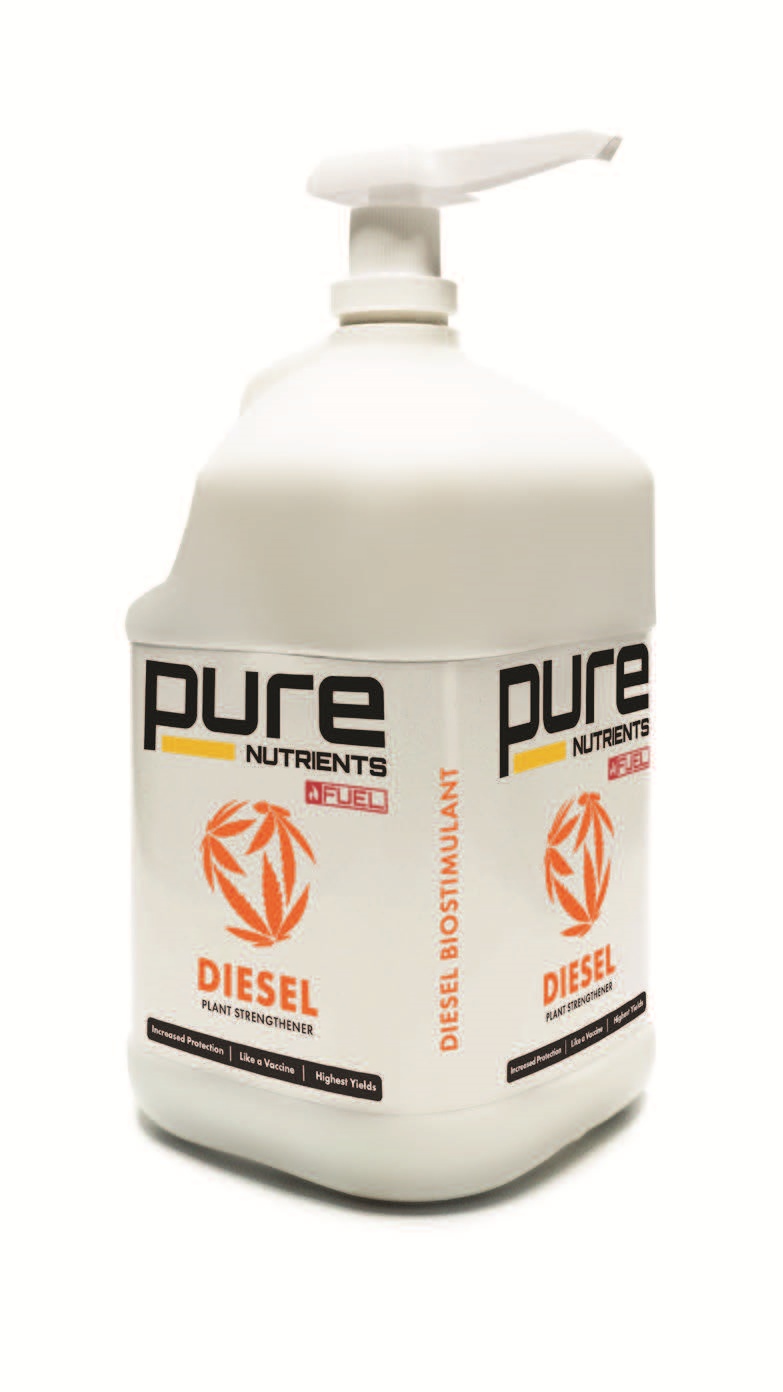
PURE DIESEL® Biostimulant
PURE DIESEL® Biostimulant
PURE DIESEL® is a liquid cultivation supplement whose current product information identifies monosilicic acid and salicylic acid as key components. It is designed to be incorporated into an established crop program at low application rates.
Current feed directions
- Rooting / cloning: 1 mL per gallon of feed water, one application
- Vegetative: 1 mL per gallon, once per week
- Flowering: 1 mL per gallon, once per week through week 5
Available sizes
- 4 L
- 20 L
Larger commercial formats may be available by request.
Regulatory and trial note
Use the current product label for permitted applications. Nutrition or biostimulant positioning should not be interpreted as authorization for pesticide or disease-control claims. Confirm compatibility before combining with other concentrated inputs, biologicals, oxidizers or foliar programs.
Read How to Evaluate Biostimulant Claims for a measurement-first trial approach.
Available formats
- 4 Liter
- 20 Liter
Commercial pricing and support are aligned to territory, facility scale, application and the outcome your team needs to repeat.
Discuss fit, pricing & availabilityThe Pure standard
A product earns its place by strengthening the operation.
Supported with practical guidance a commercial cultivation team can actually repeat.
Clear specifications and current technical documents help decision-makers defend the choice.
Why it belongs in the system
The purchase is only useful if the result becomes repeatable.
Discuss the applicationProduct guide
What you need to know before you choose.
A practical technical summary for commercial growers and facility teams.
What it is
A liquid biostimulant/crop supplement whose current product information identifies monosilicic acid and salicylic acid as key components.
Problem it solves
Provides a repeatable supplemental input for growers evaluating silicon- and salicylic-acid-based crop-support strategies within an established nutrition program.
Who it is for
Commercial growers running controlled trials of plant-strength and stress-response supplements alongside a stable base nutrient and environmental program.
Materials & compatibility
The current product information describes root-zone/feed-stock use and foliar application. Confirm compatibility with stock tanks, filters, biological inputs, oxidizers and other concentrated products before combining.
How it is used
Current directions list 1 mL per gallon once during rooting/cloning, 1 mL per gallon once per week in vegetative growth, and 1 mL per gallon once per week through week 5 of flowering. Follow the current label.
Sizes & formats
4 L and 20 L formats are currently listed, with larger commercial formats referenced as available by request.
Commercial applications
Supplemental commercial fertigation or foliar programs where the facility has chosen to trial the formulation and the current label permits the intended application.
Limitations & cautions
Do not interpret nutrition or biostimulant positioning as a registered pesticide claim. Historical product copy includes pest/disease language; confirm the current label and applicable regulatory authorization before making such claims or using the product for that purpose.
Supporting documentation
Current product directions and formulation description are on the product page. Request the current technical sheet, label and any supporting trial data before commercial specification.
Frequently asked questions
Q: Is PURE DIESEL a pesticide?
A: Do not assume so. Use the current label and regulatory status to determine permitted claims and uses.
Q: What sizes are listed?
A: 4 L and 20 L.
Q: How should commercial growers assess it?
A: Run a controlled trial against the current standard and measure crop response, cost and compatibility.
A: Do not assume so. Use the current label and regulatory status to determine permitted claims and uses.
Q: What sizes are listed?
A: 4 L and 20 L.
Q: How should commercial growers assess it?
A: Run a controlled trial against the current standard and measure crop response, cost and compatibility.